


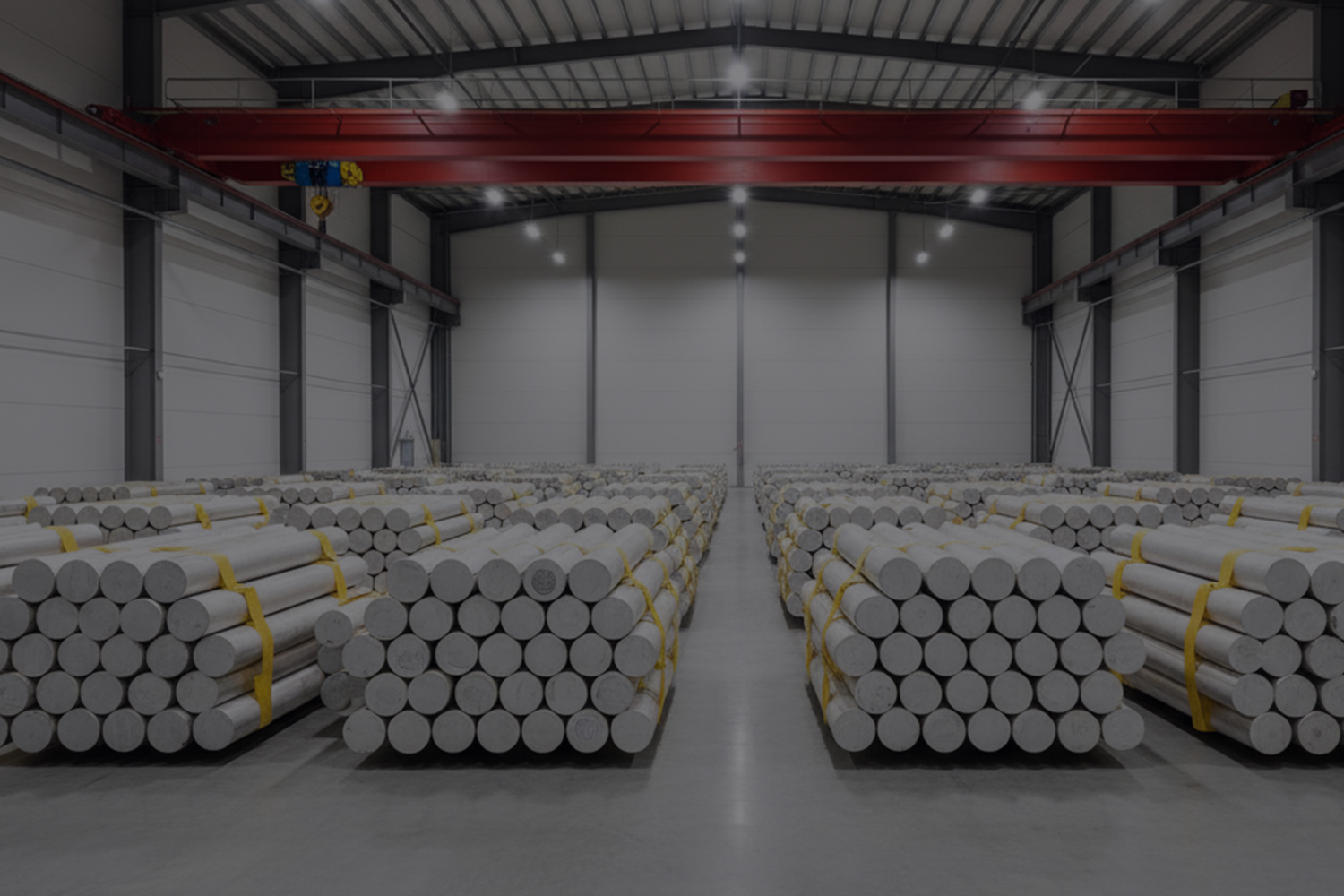
Introduction: Billet Quality Defines Extrusion Quality
In aluminium extrusion, no amount of press capacity, die sophistication, or surface finishing can compensate for poor billet quality.
For high-performance industrial applications, the billet is not just a raw input. It is the metallurgical foundation that determines:
- Mechanical strength
- Surface finish consistency
- Dimensional tolerance
- Extrusion stability
- Long-term reliability
This is why global OEMs increasingly evaluate aluminium suppliers not only on extrusion capability, but on billet metallurgy and alloy control discipline.
This blog explains how aluminium billet quality and alloy control directly influence extrusion outcomes, and why it matters for demanding industrial, automotive, infrastructure, and export applications.
What Is Aluminium Billet Quality?
Billet quality is defined by a combination of metallurgical and physical characteristics, including:
- Chemical composition accuracy
- Grain structure and uniformity
- Internal cleanliness
- Homogenization effectiveness
- Surface condition
Each of these factors affects how aluminium behaves during extrusion and how the final profile performs in real-world use.
Alloy Control: The Core of Billet Quality
Why Alloy Composition Matters
Aluminium extrusion alloys, especially from the 6xxx series, rely on precise balances of:
- Magnesium (Mg)
- Silicon (Si)
- Iron (Fe)
- Manganese (Mn)
- Trace elements
Even small deviations can significantly alter:
- Extrusion pressure and speed
- Surface finish quality
- Heat treatment response
- Final mechanical properties
This makes alloy control a non-negotiable requirement for consistent extrusion.
Strength Is Engineered at the Alloy Level
Mechanical strength in aluminium extrusions is influenced by:
- Alloy composition
- Grain refinement
- Homogenization quality
- Heat treatment response
Billets with controlled chemistry enable:
- Predictable yield and tensile strength
- Uniform elongation
- Reliable fatigue performance
For load-bearing and safety-critical components, this predictability is essential.
Impact of Alloy Control on Surface Finish
Surface Quality Starts Inside the Billet
Many surface defects originate not at the die, but within the billet itself.
Common billet-related surface issues include:
- Pick-up and tearing
- Die lines and streaking
- Inconsistent anodizing response
These are often caused by:
- Excess iron content
- Poor melt cleanliness
- Inadequate homogenization
High-quality billets with controlled alloy chemistry produce smoother, cleaner extrusion surfaces, reducing downstream finishing issues.
Importance for Architectural and Visible Applications
For applications such as:
- Architectural façades
- Transportation interiors
- Consumer-facing infrastructure
Surface consistency is critical. Alloy-controlled billets ensure:
- Uniform appearance
- Consistent color after anodizing or coating
- Reduced rejection rates
Grain Structure and Its Role in Extrusion Performance
Why Grain Uniformity Matters
Grain structure influences how aluminium flows through the die.
Fine, uniform grains provide:
- Balanced metal flow
- Reduced internal stress
- Improved dimensional stability
Coarse or uneven grains can lead to:
- Flow imbalance
- Distortion
- Reduced die life
Grain refinement is achieved through:
- Controlled casting practices
- Proper alloying
- Optimized cooling rates
Homogenization: Preparing the Billet for Precision Extrusion
After casting, billets undergo homogenization heat treatment.
Purpose of Homogenization
- Eliminates chemical segregation
- Dissolves low-melting-point phases
- Improves billet workability
- Enhances surface finish quality
Proper homogenization ensures:
- Stable extrusion speeds
- Consistent tolerance control
- Reduced risk of cracking or tearing
This step is critical for high-tolerance and complex profiles.
Tolerance Control Begins with Billet Consistency
Dimensional tolerance in extrusion is influenced by:
- Billet chemistry consistency
- Uniform billet temperature
- Predictable metal flow
When billets vary from batch to batch, extrusion parameters must constantly be adjusted, increasing:
- Scrap rates
- Dimensional variation
- Production instability
Consistent billet quality enables stable process windows and repeatable tolerances.
Alloy Control and Heat Treatment Response
Extrusion alloys are designed to respond to specific heat treatments (T5, T6).
Poor alloy control can result in:
- Inconsistent hardness
- Reduced strength
- Variable aging response
High-quality billets ensure:
- Uniform heat treatment results
- Predictable mechanical performance
- Reliable compliance with specifications
This is especially important for automotive, rail, and industrial applications.
Role of In-House Billet Casting in Quality Assurance
Manufacturers with in-house billet casting gain:
- Full control over alloy chemistry
- Better scrap segregation
- Faster corrective action
- Improved traceability
This integration minimizes external variability and strengthens overall quality control.
This is a key reason why integrated manufacturers like VAEC Aluminium Extrusion Pvt Ltd are preferred by global buyers.
Quality Testing and Validation of Billets
Advanced extrusion plants validate billet quality through:
- Spectrometric chemical analysis
- Microstructure examination
- Density and inclusion testing
- Homogenization verification
These tests ensure billets meet both:
- Internal quality benchmarks
- Customer and international standards
Why Billet Quality Matters to Global Buyers
From a buyer’s perspective, billet quality influences:
- Product reliability
- Production yield
- Surface finishing success
- Long-term supply consistency
For OEMs, inconsistent billet quality introduces:
- Assembly issues
- Field failures
- Increased warranty risk
This makes billet quality a strategic sourcing criterion, not a background detail.
VAEC Aluminium Extrusion Pvt Ltd: Metallurgy-Led Quality Philosophy
VAEC Aluminium Extrusion Pvt Ltd treats billet quality as a core manufacturing discipline, not a procurement activity.
By focusing on:
- Alloy accuracy
- Controlled billet casting
- Optimized homogenization
- Integrated quality monitoring
VAEC ensures extrusion performance that is:
- Mechanically reliable
- Dimensionally consistent
- Surface-finish ready
- Scalable for global programs
Conclusion: Strong Extrusions Start with Strong Billets
In aluminium extrusion, quality is built, not corrected.
Alloy control and billet quality determine:
- Strength
- Surface finish
- Dimensional accuracy
- Process stability
Manufacturers who invest in billet metallurgy deliver not just profiles, but confidence and consistency to their customers.
For high-performance applications, billet quality is not optional. It is foundational.


